For Business

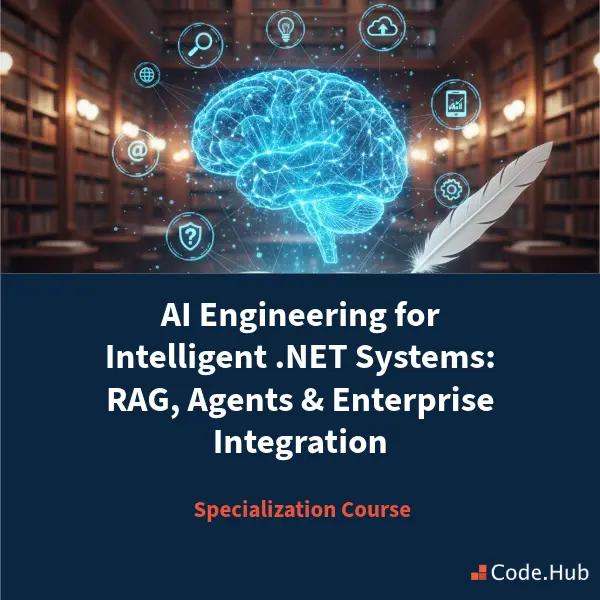
AI Engineering for Intelligent .NET Systems: RAG, Agents & Enterprise Integration
Certificate of Completion by Code.Hub
This course explores how to design and build intelligent, AI-powered applications within .NET ecosystems using modern techniques such as Retrieval-Augmented Generation (RAG), agent-based workflows, and enterprise-grade AI integration. Participants will learn how to extend ASP.NET Core systems with large language models, connect AI to structured and unstructured data sources, and orchestrate multi-step reasoning using agents. The course emphasizes practical implementation using Azure OpenAI, Semantic Kernel, and vector-based retrieval, enabling the development of scalable, secure, and production-ready AI features. Through hands-on exercises, learners will build end-to-end intelligent services that go beyond traditional APIs.
By the end of this module, participants will be able to:
- Design and implement AI-powered APIs using ASP.NET Core
- Build RAG pipelines integrating SQL Server and vector search
- Develop agent-based workflows using Semantic Kernel or similar frameworks
- Integrate Azure OpenAI securely within enterprise architectures
- Evaluate and improve AI system responses and reliability
AI System Architecture in .NET Introduction to LLMs & Enterprise Integration From APIs to Intelligent Services
Foundations of AI-powered systems
- Overview of LLM capabilities and limitations Integrating Azure OpenAI with ASP.NET Core APIs Designing AI-native endpoints vs traditional APIs Architectural patterns for AI-enabled services AI Practice: Build a simple ASP.NET Core endpoint that calls an LLM to process user input
Retrieval-Augmented Generation (RAG) Data Integration (SQL + Documents) Embeddings & Vector Search
Building RAG pipelines
- Concepts of embeddings and vector databases Connecting SQL Server and external documents to LLMs Implementing retrieval pipelines with Azure AI Search or similar Improving response accuracy using contextual data AI Practice: Build a RAG pipeline that retrieves data from SQL Server and enhances LLM responses
Agent-Based Systems Semantic Kernel / Agent Frameworks Tool Usage & Multi-step Reasoning
Designing agent workflows
- Agent architecture (tools, memory, orchestration) Implementing multi-step workflows (task → reasoning → action) Using Semantic Kernel or LangGraph concepts in .NET Integrating APIs and tools into agent flows AI Practice: Create a simple agent that processes a task, queries data, and returns a structured response
Enterprise Integration & Evaluation Security & Responsible AI AI System Testing & Optimization
Production readiness and evaluation
- Secure integration with Azure OpenAI (private endpoints, data control) Handling hallucinations and response validation Evaluation techniques for AI outputs (quality, relevance) Monitoring and improving AI system performance AI Practice: Evaluate AI responses, detect issues, and refine prompts or retrieval strategy for improved accuracy
Roles:
- Software Engineers/ Architects (.NET, Backend, Full stack)
- DevOps / SRE Engineers
- CTOs / Engineering Managers
Seniority:
- Mid-Senior
- Experience with .NET (ASP.NET Core Web APIs) and basic database concepts
- Familiarity with REST APIs and general software architecture
Sessions can be delivered via the following formats:
- Live Online – Interactive virtual sessions via video conferencing
- On-Site – At your organization’s premises
- In-Person – At Code.Hub’s training center
- Hybrid – A combination of online and in-person sessions
Ready to apply?
~3 minutes · Name, email, phone!
ApplyShare Link
Interested for
AI Engineering for Intelligent .NET Systems: RAG, Agents & Enterprise Integration