For Business

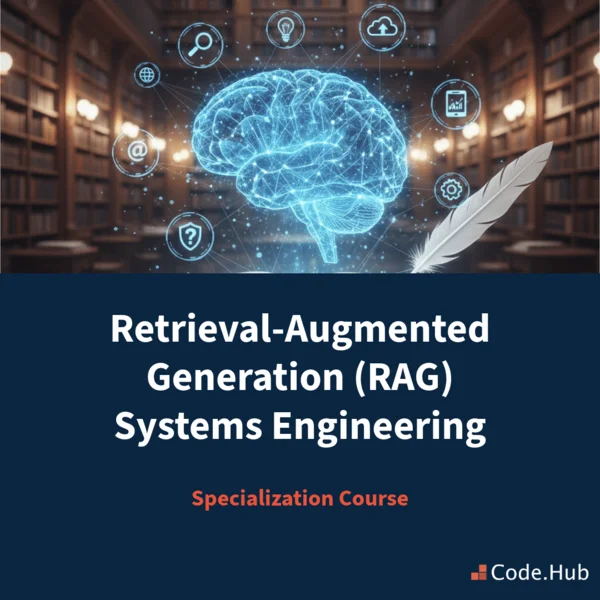
Retrieval-Augmented Generation (RAG) Systems Engineering
Certificate of Completion by Code.Hub
This course provides a comprehensive, engineering-focused approach to designing and implementing Retrieval-Augmented Generation (RAG) systems for real-world applications. It covers how to combine Large Language Models with external knowledge sources to improve accuracy, reduce hallucinations, and enable context-aware reasoning. Participants will learn end-to-end RAG architectures, including document ingestion, embeddings, vector databases, retrieval strategies, and response generation. The course also explores advanced topics such as hybrid retrieval, multi-hop reasoning, and evaluation of RAG systems. Hands-on labs focus on building scalable, production-ready pipelines using modern frameworks and cloud services. Emphasis is placed on performance, relevance, security, and system observability. By the end of the course, participants will be able to engineer robust RAG systems for enterprise use cases.
By the end of this module, participants will be able to:
- Design and implement end-to-end RAG architectures for real-world applications
- Build and optimize document ingestion, embedding, and retrieval pipelines
- Apply hybrid and advanced retrieval techniques to improve relevance and accuracy
- Evaluate, monitor, and fine-tune RAG systems for production environments
- Integrate RAG systems into APIs and intelligent applications
Foundations of RAG Systems LLM Limitations & Motivation
Introduction to RAG
- What is RAG and why it is needed
- LLM limitations (hallucinations, context limits)
- Overview of RAG architecture
AI Practice: Use an LLM to compare answers with and without retrieval
RAG Architecture Deep Dive
- Components: ingestion, embeddings, retrieval, generation
- Data flow in RAG systems
- System design considerations
AI Practice: Design a RAG architecture for a business use case
Data Ingestion & Processing Document Engineering
Document Ingestion Pipelines
- Data sources (PDFs, APIs, databases)
- Parsing and preprocessing
- Chunking strategies
AI Practice: Generate chunking strategies using AI
Embeddings & Vectorization
- Embedding models
- Semantic similarity concepts
- Vector creation workflows
AI Practice: Compare embedding outputs for different texts
Retrieval Systems Vector Databases
Vector Databases & Indexing
- Intro to vector DBs (FAISS, Pinecone, etc.)
- Indexing strategies
- Similarity search
AI Practice: Query a vector store using AI-generated queries
Retrieval Strategies
- Top-k retrieval
- Filtering and ranking
- Context window optimization
AI Practice: Tune retrieval parameters using AI suggestions
Advanced Retrieval Hybrid & Multi-hop
Hybrid Retrieval
- Combining keyword + semantic search
- BM25 + embeddings
- Re-ranking techniques
AI Practice: Generate hybrid search queries with AI
Multi-hop Reasoning
- Complex query handling
- Multi-step retrieval
- Query decomposition
AI Practice: Use AI to break down complex questions into sub-queries
RAG Integration Application Layer
RAG with APIs
- Integrating RAG into backend systems
- API design patterns
- Response formatting
AI Practice: Build a RAG-powered API endpoint
Prompt Engineering for RAG
- Context injection strategies
- Prompt templates
- Controlling hallucinations
AI Practice: Optimize prompts for better RAG responses
Evaluation & Optimization Production Systems
Evaluation Metrics
- Accuracy, relevance, latency
- Human vs automated evaluation
- Benchmarking RAG systems
AI Practice: Evaluate RAG outputs using AI-generated criteria
Scaling & Capstone Project
- Scaling RAG systems
- Monitoring and observability
- Final project implementation
AI Practice: Build and optimize a full RAG system
Roles:
- AI Engineer
- Data Engineer
- Machine Learning Engineer
- AI Solutions Architect
Seniority:
- Junior
- Mid-Level
- Experience with Python or .NET and familiarity with APIs and data processing
- Basic understanding of machine learning concepts and LLM fundamentals
Sessions can be delivered via the following formats:
- Live Online – Interactive virtual sessions via video conferencing
- On-Site – At your organization’s premises
- In-Person – At Code.Hub’s training center
- Hybrid – A combination of online and in-person sessions
Ready to apply?
~3 minutes · Name, email, phone!
ApplyShare Link

Interested for
Retrieval-Augmented Generation (RAG) Systems Engineering