For Business

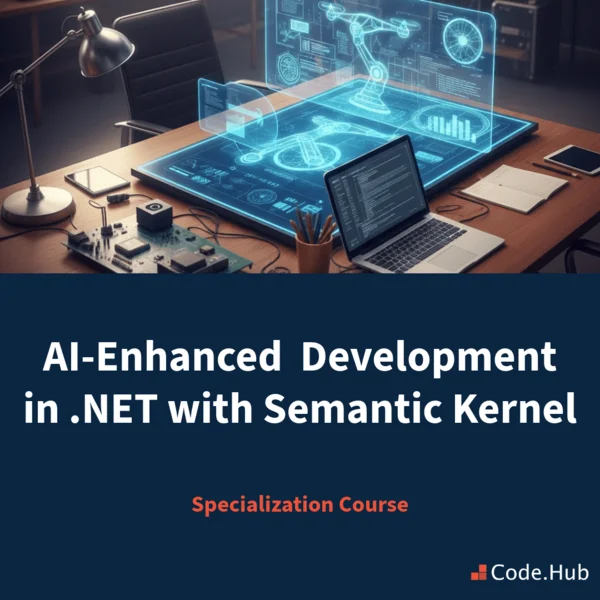
AI-Enhanced Development in .NET with Semantic Kernel
Certificate of Completion by Code.Hub
Participants will learn how to integrate Large Language Models (LLMs) into ASP.NET Core applications, design structured prompts, and orchestrate AI workflows using plugins, memory, and Retrieval-Augmented Generation (RAG). The course emphasizes real-world architecture patterns, including API design, AI service abstraction, and secure, scalable deployment.
By the end of this module, participants will be able to:
- Design and implement AI-powered Web APIs using .NET and Semantic Kernel
- Build and use plugins to connect AI with real business logic and systems
- Develop end-to-end applications with frontend interaction (chat-based or task-driven)
- Apply security best practices (prompt injection protection, data handling)
- Monitor and optimize AI performance (latency, token usage, cost)
AI in .NET and prompting
What are LLMs and how they work
Role of Microsoft Semantic Kernel, Comparison with traditional APIs
Connecting to Azure OpenAI, Configuration best practices
AI practice: Build AI endpoint in ASP.NET Core
Structured prompts
Prompt templates
Input/output control
Avoiding hallucinations
AI practice: Build reusable LLM prompt templates
Plugins, Function Calling, Memory & RAG
Native functions (C#)
Tool calling
Plugin architecture
AI practice Build a plugin (e.g., customer lookup, weather API)
Embeddings
Vector databases
Retrieval-Augmented Generation (RAG)
AI practice: Build document Q&A system with AI
Building a Full AI Web API
API design patterns
AI service abstraction
Dependency injection with SK
AI practice: Build full backend (chat + plugins + RAG)
Frontend Integration
Connecting frontend to AI API
Chat UI patterns
Streaming responses
AI practice: Simple Angular chat interface
Security & Responsible AI
Prompt injection
Data leakage risks
Guardrails
Compliance considerations
AI practice: Best practices in AI compliance
Observability & Optimization
Logging prompts/responses
Token cost control
Performance tuning
AI practice: Best practices in AI observability
Agents & Automation
Planner patterns
Multi-step workflows
Agent architectures (Planner-Executor-Validator)
AI practice: Agentic AI overview
Intelligent automation systems
AI practice: Build AI agent
Banking assistant, Customer support copilot
Document Q&A system, AI-powered analytics assistant
- Roles: .NET developers transitioning into AI-enabled applications
- Seniority: Junior to Mid-Level Professionals or Senior Professionals exploring AI in enterprise environments
- Intermediate knowledge of C# and .NET (ASP.NET Core)
- Understanding of REST APIs
- Basic familiarity with cloud concepts (preferably Azure)
Sessions can be delivered via the following formats:
- Live Online – Interactive virtual sessions via video conferencing
- On-Site – At your organization’s premises
- In-Person – At Code.Hub’s training center
- Hybrid – A combination of online and in-person sessions
Ready to apply?
~3 minutes · Name, email, phone!
ApplyShare Link
Interested for
AI-Enhanced Development in .NET with Semantic Kernel