For Business

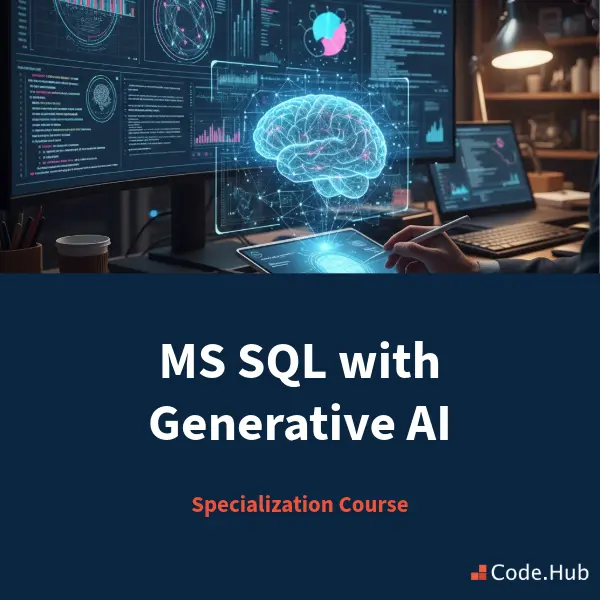
MS SQL with Generative AI
Certificate of Completion by Code.Hub
This training introduces developers and data professionals to the integration of Generative AI with Microsoft SQL Server to enhance data interaction, automation, and intelligence. Participants will learn how to use LLMs to translate natural language into SQL queries, generate insights from structured data, and build intelligent data-driven applications. The course covers architectures that combine SQL Server with vector databases, APIs, and orchestration frameworks for Retrieval-Augmented Generation (RAG). It also explores how to automate reporting, anomaly detection, and decision support using AI-enhanced pipelines. Practical labs focus on building end-to-end solutions that connect SQL Server with modern AI services such as Azure OpenAI. Emphasis is placed on performance, security, and governance when integrating AI into enterprise data environments. By the end, participants will be able to design and implement production-ready systems that augment SQL-based workflows with intelligent capabilities.
By the end of this module, participants will be able to:
- Design systems that integrate SQL Server with LLMs for intelligent data querying
- Implement natural language to SQL pipelines with validation and optimization
- Build RAG-based solutions combining structured and unstructured data sources
- Develop AI-driven dashboards and automated reporting workflows
- Apply best practices for security, governance, and performance in AI-augmented data systems
AI-Augmented Data Engineering
Role of Generative AI in modern data platforms, enterprise use cases (analytics, automation, decision intelligence)
AI Practice: Positioning of AI Copilot in SQL ecosystems
Schema Design for AI-Driven Systems
Star schemas, normalization vs denormalization, designing schemas that are AI-friendly (naming, metadata, semantics)
AI Practice: Creating schemas with Gen AI
Performance Engineering with AI
Execution plans, indexing strategies, partitioning
AI Practice: AI-assisted tuning and refactoring of complex queries
AI over Business Semantics
Building semantic layers (facts, dimensions), enabling accurate AI-driven analytics
AI Practice: AI Mapping business language to SQL,
Complex Query Orchestration
Window functions, CTE chains, nested queries
AI Practice: AI-assisted generation of analytical pipelines
AI for SQL Engineering
Generating stored procedures, ETL scripts, dynamic SQL, parameterized queries, reusable components
AI Practice: SQL scripting with AI
Retrieval-Augmented SQL Systems
Combining SQL Server with vector search, integrating structured + unstructured data
AI Practice: AI-driven data retrieval pipelines
Safe AI Usage in SQL Systems
Preventing SQL injection via AI, data access control, compliance considerations
AI Practice: Auditing AI-generated queries
Efficient AI + SQL Usage
Reducing query cost, optimizing data scans, minimizing token usage, caching strategies, workload optimization
AI Practice: AI costs and optimization best practices
End-to-End AI Data Solutions
Case studies (banking, retail, energy), building AI copilots for analytics, decision support systems
AI Practice: AI data architectures and use cases
- Roles: Data Analyst, Business Intelligence Manager, Digital Transformation Manager
- Seniority: Mid to Senior Level
- Basic understanding of SQL querying, relational databases, and data modeling concepts
Sessions can be delivered via the following formats:
- Live Online – Interactive virtual sessions via video conferencing
- On-Site – At your organization’s premises
- In-Person – At Code.Hub’s training center
- Hybrid – A combination of online and in-person sessions
Ready to apply?
~3 minutes · Name, email, phone!
ApplyShare Link
Interested for
MS SQL with Generative AI