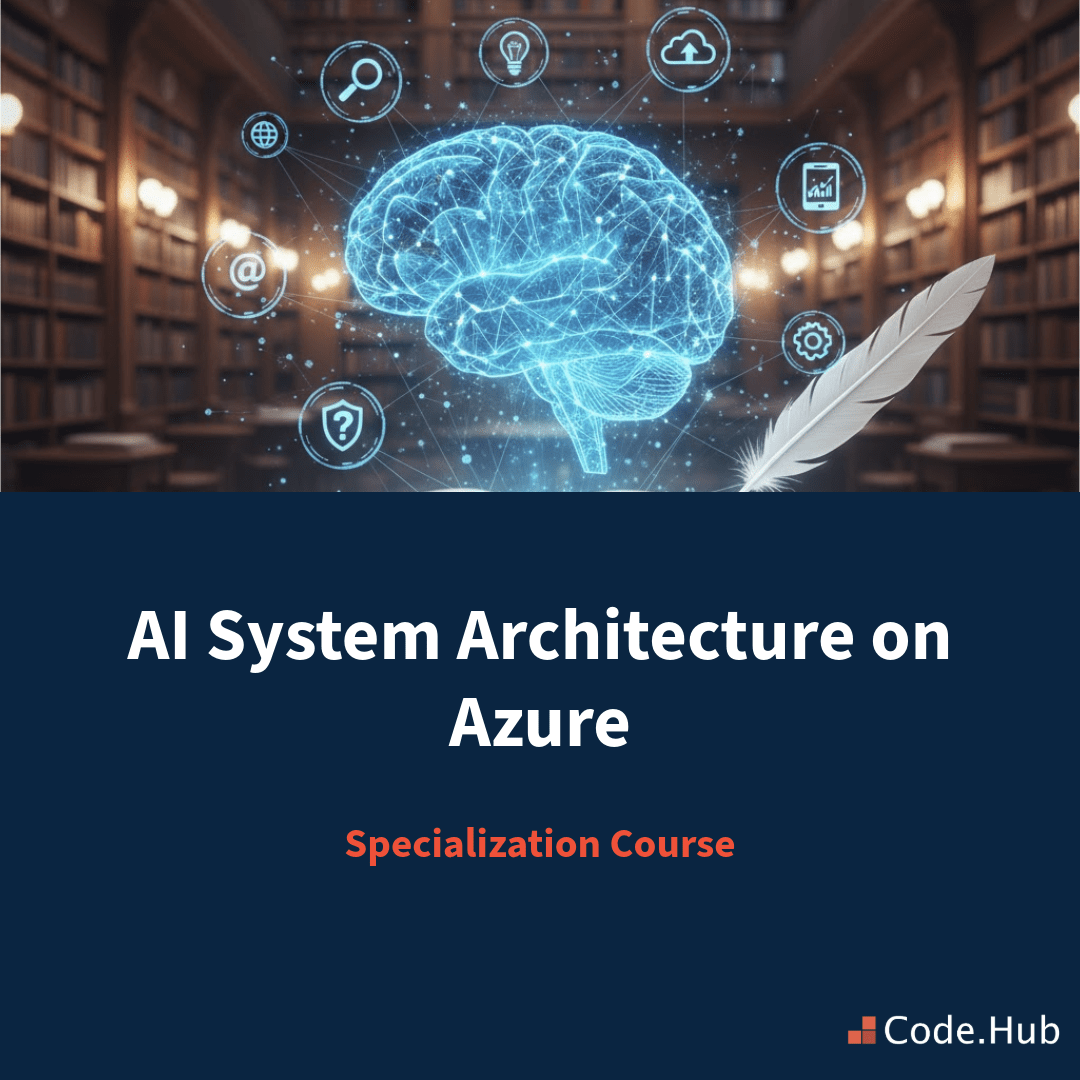
AI System Architecture on Azure
Description
This course provides a comprehensive approach to designing and implementing AI system architectures on Microsoft Azure. It covers how to build scalable, secure, and production-ready AI solutions using services such as Azure OpenAI, Azure Machine Learning, Cognitive Services, and data platforms. Participants will learn how to architect end-to-end pipelines that integrate data ingestion, model inference, RAG systems, and agent-based workflows. The course emphasizes cloud-native design principles, including microservices, event-driven architectures, and distributed systems. Hands-on labs focus on building real-world AI solutions with proper security, identity management, and monitoring. Special attention is given to governance, cost optimization, and performance tuning. By the end of the course, participants will be able to design enterprise-grade AI architectures on Azure.
🕒 Duration: 24 hours
👥 Target Audience:
- Roles:
AI Engineer, Data Engineer, Machine Learning Engineer, AI Solutions Architect
- Seniority:
Junior, Mid-Level
Webinar Content
|
Module 1: Foundations of Azure AI Architecture
Cloud & AI Fundamentals |
Introduction to AI Architecture on Azure |
|
| Azure Core Services for AI |
|
|
|
Module 2: AI Services Integration
LLM & Cognitive Services |
Azure OpenAI Integration |
|
| Cognitive Services & AI APIs |
|
|
|
Module 3: Data & RAG Systems
Knowledge Architectures |
Data Platforms for AI |
|
| RAG on Azure |
|
|
|
Module 4: Microservices & APIs
Distributed Systems |
AI-Driven Microservices |
|
| Event-Driven Architectures |
|
|
|
Module 5: Security & Governance
Enterprise AI |
Identity & Access Management |
|
| AI Governance & Compliance |
|
|
|
Module 6: Observability & Optimization
Production Systems |
Monitoring & Logging |
|
| Cost Optimization & Capstone |
|
Learning Objectives:
After attending this webinar participants will be able to:
- Design end-to-end AI architectures using Azure services and cloud-native patterns
- Integrate Azure OpenAI, data platforms, and APIs into scalable AI solutions
- Implement RAG and agent-based systems within Azure environments
- Apply security, identity, and governance best practices for AI workloads
- Optimize performance, cost, and observability in production AI systems
Prerequisite Knowledge
- Experience with cloud concepts and basic Azure services (compute, storage, networking)
- Familiarity with APIs, data processing, and basic AI/LLM concepts