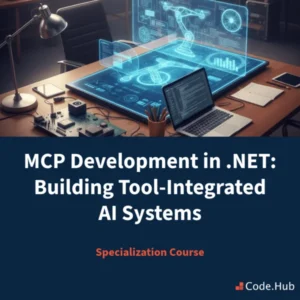
MCP Development in .NET: Building Tool-Integrated AI Systems
Description
This training introduces developers to building AI-powered applications in .NET using the Model Context Protocol (MCP), enabling seamless integration between Large Language Models and external tools, APIs, and data sources. Participants will learn how to design and implement MCP servers and clients in .NET, exposing structured capabilities such as functions, data access, and workflows to LLMs. The course covers tool definition, schema design, context management, and secure execution of AI-triggered operations. Through hands-on labs, learners will build intelligent systems where LLMs orchestrate actions such as querying databases, invoking services, and automating workflows. The training also explores integration with platforms like Azure OpenAI and local LLM runtimes, emphasizing interoperability and extensibility. Special focus is given to reliability, validation, observability, and governance in production-grade MCP systems. By the end of the course, participants will be able to design robust, tool-driven AI applications using .NET as the orchestration backbone.
Indicative Duration: 12 training hours
*Duration is adjusted based on the final scope and the target audience.
Scope
|
1. MCP Concepts
|
1.1 Introduction to MCP and AI Tooling |
โข What is MCP and why it matters โข MCP vs function calling vs plugins โข Role of MCP in agentic systems โข Architecture overview (.NET + LLM + Tools) |
| 1.2 MCP Core Concepts | MCP primitives: โข Tools โข Resources โข Prompts โข JSON schema definitions โข Context propagation โข Capability discovery |
|
|
2. MCP development
|
2.1 Building MCP Servers in .NET |
โข Creating MCP-compatible endpoints โข Defining tools with schemas โข Handling tool execution requests โข Dependency injection and modular design |
| 2.2 Hands-on | โข Build an MCP server exposing: โข SQL query tool โข REST API tool |
|
| 2.3 MCP Clients & LLM Integration |
โข Connecting MCP to LLMs (Azure OpenAI / local models) โข Tool selection and invocation โข Prompt + schema orchestration โข Handling multi-step reasoning |
|
| 2.4 Advanced Patterns | โข Multi-tool orchestration โข Agent workflows (Planner / Executor) โข Memory and context management โข Combining MCP with RAG systems |
|
|
3. MCP in production
|
3.1 Security, Validation and Governance |
โข Input/output validation โข Safe tool execution (guardrails) โข Role-based access โข Logging and observability |
| 3.2 Production Architecture | โข Scaling MCP services โข Integration with microservices โข API gateways and security layers Deployment (Docker, Azure) |
|
| 4. Use case | 4.1 AI Assistant with MCP (.NET) Features |
โข Natural language -> tool execution โข SQL Server integration โข External API calls โข Response explanation |
Learning Objectives
Upon completion of the course participants will be able to:
- Design and implement MCP servers in .NET exposing tools, resources, and structured capabilities
- Build MCP clients that enable LLMs to interact with APIs, databases, and external systems
- Integrate MCP-based systems with Azure OpenAI or local LLMs for tool-augmented reasoning
- Apply validation, security, and governance controls for safe execution of AI-driven actions
- Architect scalable, production-ready AI systems using MCP and modern .NET patterns
Target Audience
- Roles: .NET Developer, AI/ML Engineer, Solutions Architect
- Seniority: Mid to Senior Level
Prerequisite Knowledge
- Solid experience with C# and the .NET ecosystem including Visual Studio and basic application architecture
- Familiarity with REST APIs and general software development lifecycle practices
Delivery Method
Sessions can be delivered via the following formats:
- Live Online โ Interactive virtual sessions via video conferencing
- On-Site โ At your organizationโs premises
- In-Person โ At Code.Hubโs training center
- Hybrid โ A combination of online and in-person sessions