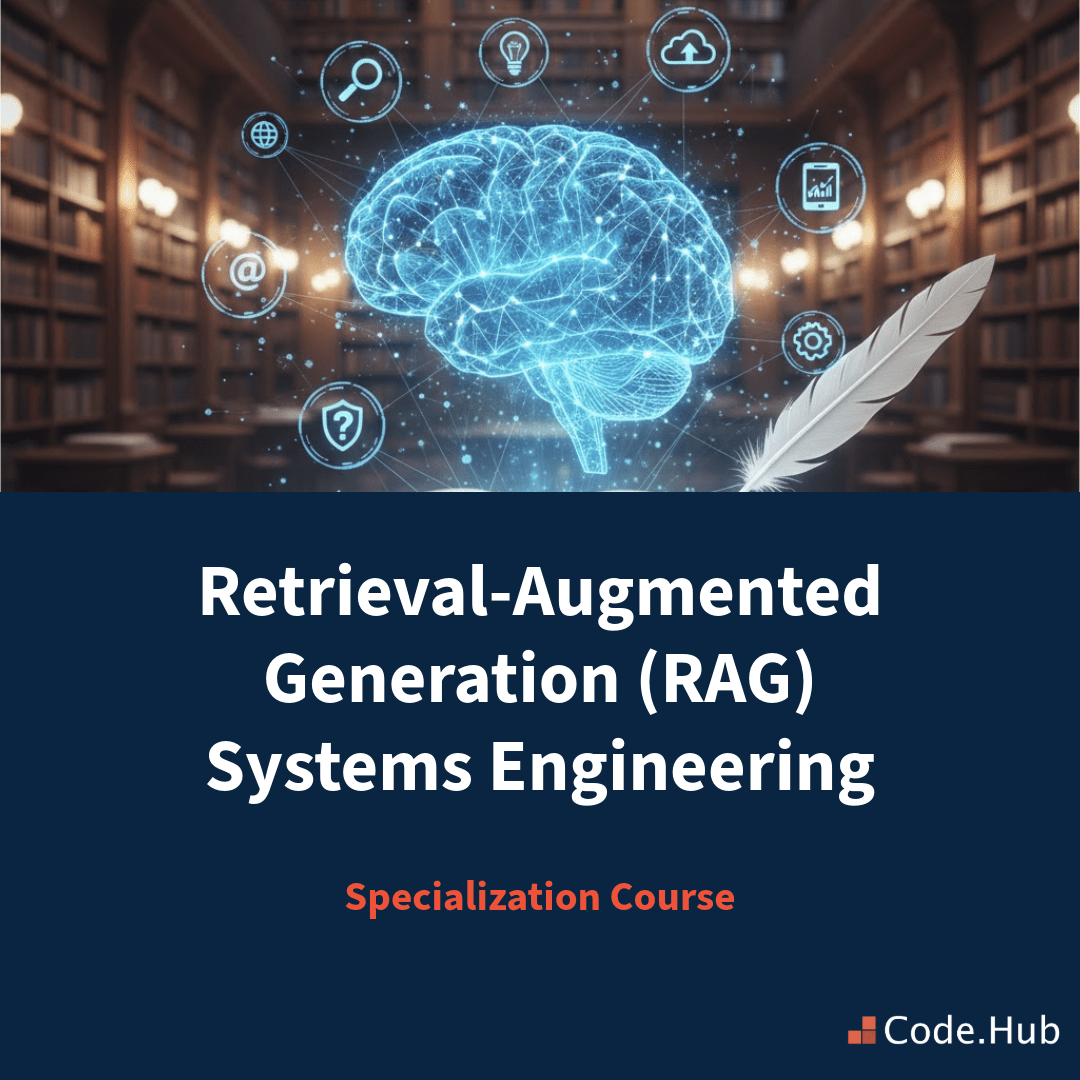
Retrieval-Augmented Generation (RAG) Systems Engineering
Description
This course provides a comprehensive, engineering-focused approach to designing and implementing Retrieval-Augmented Generation (RAG) systems for real-world applications. It covers how to combine Large Language Models with external knowledge sources to improve accuracy, reduce hallucinations, and enable context-aware reasoning. Participants will learn end-to-end RAG architectures, including document ingestion, embeddings, vector databases, retrieval strategies, and response generation. The course also explores advanced topics such as hybrid retrieval, multi-hop reasoning, and evaluation of RAG systems. Hands-on labs focus on building scalable, production-ready pipelines using modern frameworks and cloud services. Emphasis is placed on performance, relevance, security, and system observability. By the end of the course, participants will be able to engineer robust RAG systems for enterprise use cases.
🕒 Duration: 24 hours
👥 Target Audience:
- Roles:
AI Engineer, Data Engineer, Machine Learning Engineer, AI Solutions Architect
- Seniority:
Junior, Mid-Level
Webinar Content
|
Module 1: Foundations of RAG Systems
LLM Limitations & Motivation |
Introduction to RAG |
|
| RAG Architecture Deep Dive |
|
|
|
Module 2: Data Ingestion & Processing
Document Engineering |
Document Ingestion Pipelines |
|
| Embeddings & Vectorization |
|
|
|
Module 3: Retrieval Systems
Vector Databases |
Vector Databases & Indexing |
|
| Retrieval Strategies |
|
|
|
Module 4: Advanced Retrieval
Hybrid & Multi-hop |
Hybrid Retrieval |
|
| Multi-hop Reasoning |
|
|
|
Module 5: RAG Integration
Application Layer |
RAG with APIs |
|
| Prompt Engineering for RAG |
|
|
|
Module 6: Evaluation & Optimization
Production Systems |
Evaluation Metrics |
|
| Scaling & Capstone Project |
|
Learning Objectives:
After attending this webinar participants will be able to:
- Design and implement end-to-end RAG architectures for real-world applications
- Build and optimize document ingestion, embedding, and retrieval pipelines
- Apply hybrid and advanced retrieval techniques to improve relevance and accuracy
- Evaluate, monitor, and fine-tune RAG systems for production environments
- Integrate RAG systems into APIs and intelligent applications
Prerequisite Knowledge
- Experience with Python or .NET and familiarity with APIs and data processing
- Basic understanding of machine learning concepts and LLM fundamentals